



The Story Path · From the workshop
The Black Line
ebonise: to make wood black, like ebony
Every path on a Story Path tile is a black line in the oak. There’s no paint in it and no dye, only iron and the oak’s own tannin. People have been making black from iron and tannin for centuries. This is the story of how it reached our workshop.
Iron and oak galls
Written in iron
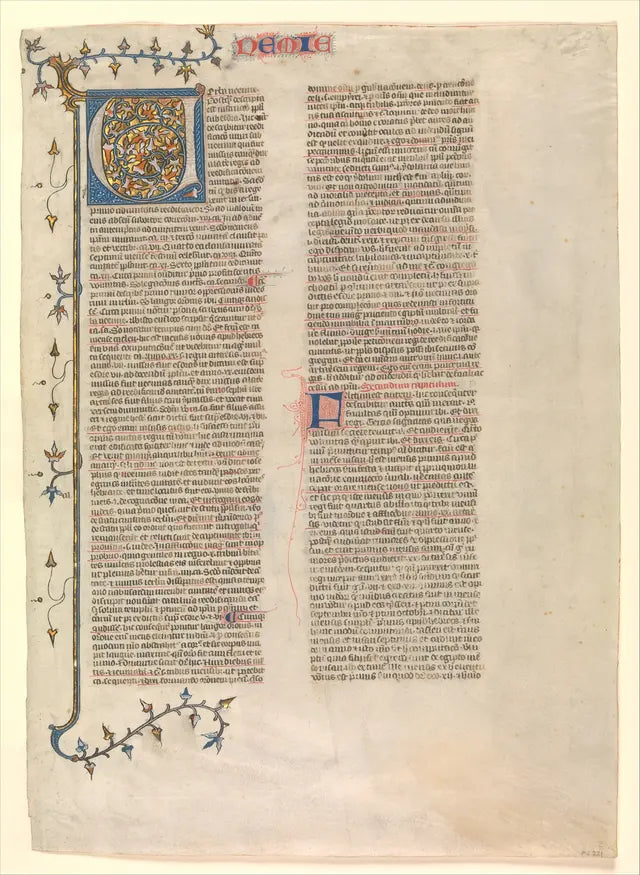
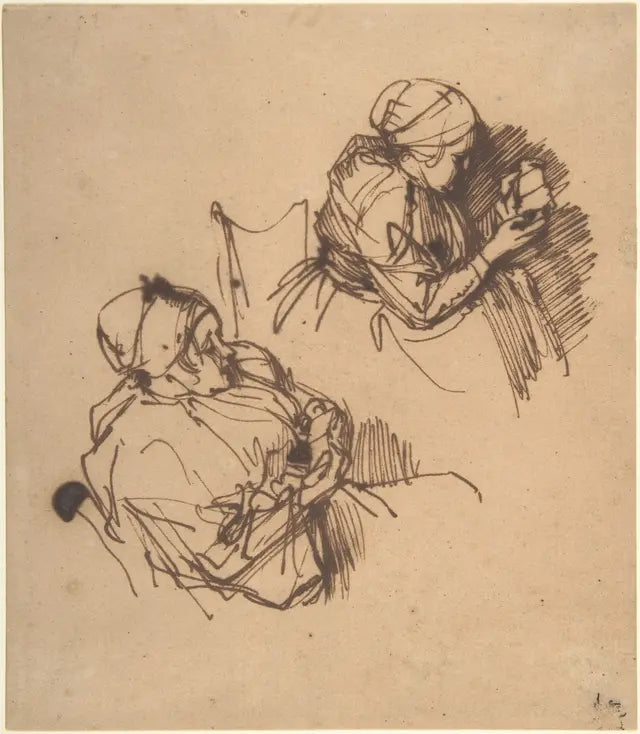
Long before anyone blackened a chair, people wrote in iron.
The Royal Collection describes Leonardo’s ink as made “by mixing iron salts with tannic acid from oak galls (oak apples) to give a thick black ink”: iron-gall ink.
On Leonardo’s pages, the Royal Collection says, it has mellowed over the centuries to a warm chestnut.
The 1600s
Wood dressed as ebony
Ebony came from India and Africa and was prized for its black.
Cabinetmakers learned to imitate it on cheaper woods, and the result is called ebonised.
The V&A has a Dutch linen press of 1630–50, oak with “applied motifs in ebonised wood”, and an Antwerp table cabinet of 1640–60 that sets real ebony beside ebonised wood on an oak carcase.
As natural ebony is so very expensive it is usually imitated by means of stains. J. C. S. Brough, Staining and Polishing, 1918
London, 1867
A sideboard in black
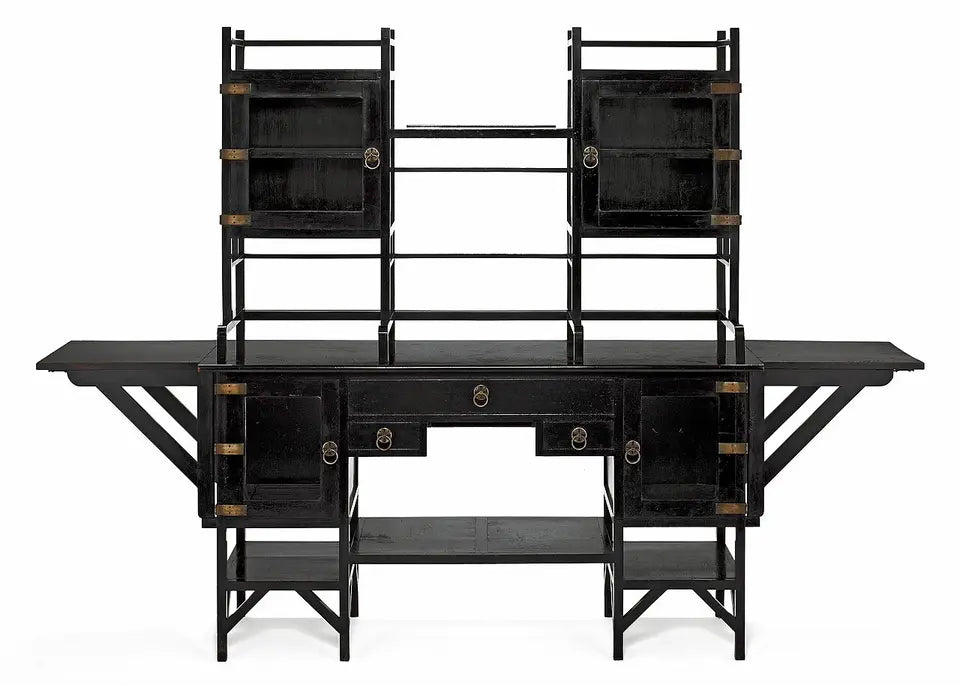
In 1867 the architect E. W. Godwin designed an ebonised sideboard for his own dining room.
The first was ebonised deal, a cheap wood. When the deal proved unstable he changed to ebonised mahogany, and at least ten were made over the next twenty years.
The V&A says it “epitomises the influence of Japanese art and design on British decorative art in the 1860s and 1870s.”
Morris & Co.
The Sussex chair
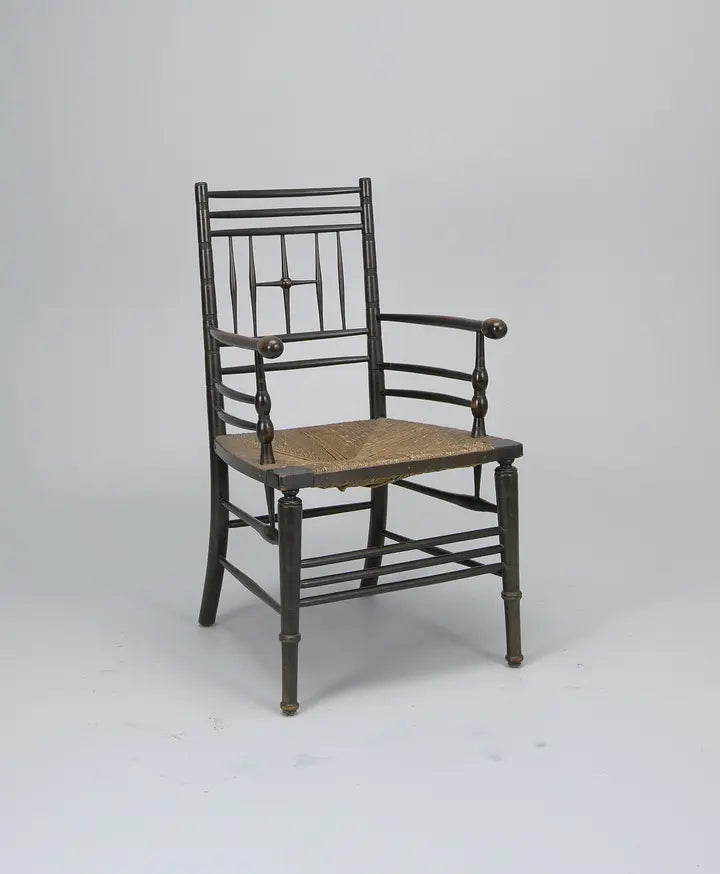
From the 1860s William Morris’s firm made a rush-seated chair with a turned, ebonised frame, “adapted from a traditional vernacular pattern” and credited to Philip Webb.
They made it in large quantities, and William and Jane Morris had Sussex chairs at Red House and at Kelmscott House.
Black country chairs were nothing new. In north-west England in the early 1800s, customers could have their chair frames stained black, or stained to look like mahogany.
The recipe books
Iron, and something with tannin
The cabinetmakers’ manuals of the 1800s are full of ebonising recipes, and nearly all of them pair iron with oak galls, oak bark or logwood.
Procure some liquor from a tanner’s pit, or make a strong decoction of oak-bark, and for every gallon of the liquor take a quarter of a pound of green copperas. G. A. Siddons, The Cabinet Maker’s Guide, 1837. Green copperas is iron sulphate.
Ours is the same pairing: iron and oak.
Our workshop
A jar of vinegar, a teaspoon of wire wool, and a dragon
It started last year as a puzzle: jigsaw pieces with dragons on.
The jigsaw joints never felt right, so one of Harley’s first jobs as our apprentice was to find another way for the pieces to join. He came back with arrows.
Arrows want somewhere to go. The animals became scenes, and the scenes needed a path running through them, from one tile to the next. A path wants a beginning and an end, so we made two: Once upon a time, and The End. And every story needs a hero, so the first page got the child’s name.
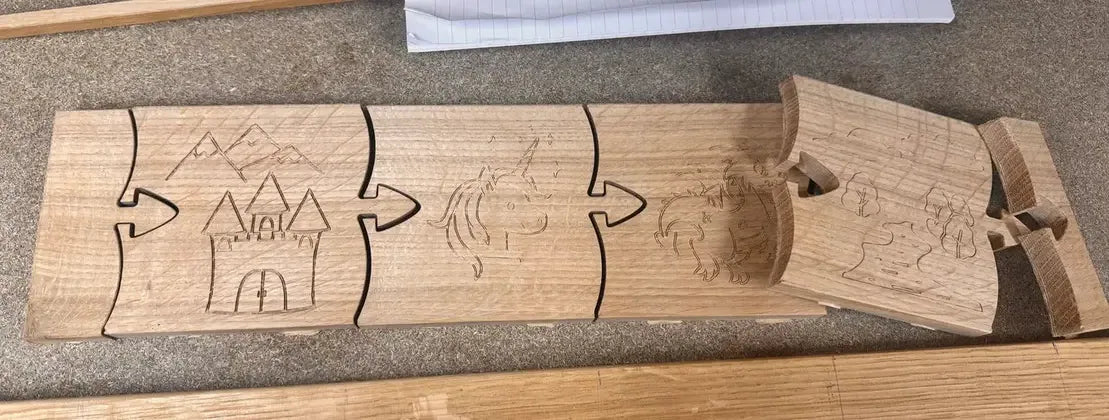
Planed
I of VI · A rough board goes through the planer.
Shellacked
II of VI · Shellac, wiped on by hand before engraving.
Engraved
III of VI · Every line is cut into the oak with a fine V-bit.
The jar
Iron in vinegar
What it didn’t have was lines you could see.
The engraving was beautiful up close and vanished across a room, and we didn’t want paint or dye on a child’s toy. So we went looking for how wood was blackened before paint came in tins, and found a recipe that sounded made up: put iron in vinegar, wipe it on oak.
Put some rusty nails or old iron into a bottle with some vinegar, and when it begins to work give the furniture a coat of the vinegar. Workshop Receipts, 1883
The jar
We don’t work with metal, and we don’t clean much either. The vinegar came from home, from the five-gallon jug that lives in the cupboard (bought in bulk from Amazon, where we’re happy to shop, even if you won’t find us selling there), carried back to the workshop in a jar. The steel wool came back from the shops as stainless steel scouring pads, which sat in the vinegar for a week and did precisely nothing.
Across the yard
Across the yard
So Harley suggested we try Andrew, who runs Blackford Engineering across the yard. We found him working on one of his classic cars (he films them on his YouTube channel, The Vintage Workshop) and walked in holding a jar of clear liquid. Stainless pads are treated, he told us; they’ll never do anything. He found us some real wire wool, oily, about a teaspoonful, handed over with the air of a man who wasn’t giving away any more.
Across the yard
Overnight: nothing. A week: still clear vinegar with some wire in it. We decided it didn’t work and left it on the shelf. (We know now that iron dissolving in vinegar gives off hydrogen, so a tight lid wasn’t our best idea.)
A fortnight later
A fortnight later
About a fortnight later, more out of stubbornness than hope, we brushed the sludge from the bottom of the jar onto a practice tile: a dragon from last year’s puzzle. It went jet black. Not just the lines, the whole tile.
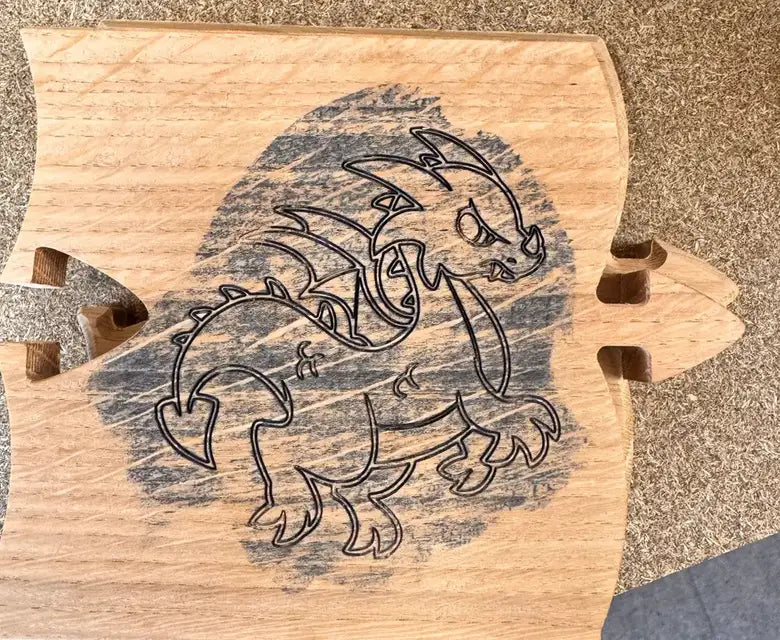
A fortnight later
It’s why every tile is now sealed with shellac first, so the iron can only reach the engraved lines. Our shellac comes from Wrights of Lymm, who also make our gold leaf, and who hold the Royal Warrant as suppliers of gold leaf and gilding products to the Royal Household.
Ebonised
IV of VI · Iron and vinegar, wiped over the engraving. Only the lines turn black.
Oiled
V of VI · Then oil, rubbed in by hand.
The magic tiles
The gold
The gold came next. Iron needs the oak’s tannin to turn black. Purpleheart and padauk have barely any, and they’re too dark to show a black line anyway. So their paths are laid in 24ct gold leaf instead, and they became the magic tiles: the wild card that joins any path, wherever the story needs it.
The first time we made these, they didn’t go to plan either. We used 20-hour size (the adhesive that holds the gold down; food safe, for the record). Little did we know that ‘20-hour’ meant size that takes twenty hours to turn tacky. No wonder our gold didn’t stick, and you can imagine our disappointment until we realised the mistake.
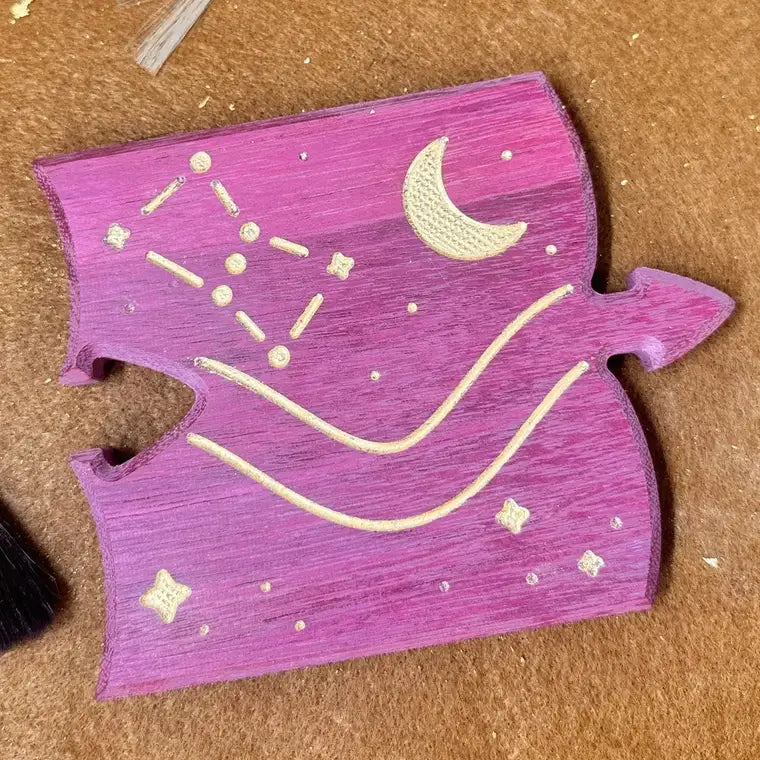
Gilded
VI of VI · Gold leaf, laid by hand into the path of a purpleheart tile.
One more wood
Osage orange
There’s one more wood in the corner of the workshop: a small stock of Osage orange, hard to find in the UK. It has enough tannin to take the black line, but gold would vanish against it. There’s only enough for about twenty tiles, so we won’t make them until we’ve found the right design.
The Story Path
Follow the line
Lay the tiles, follow the path from Once upon a time to The End, and see whose story it becomes.
Made by hand. Played by them. · the film, on the Story Path page
Planed, shellacked, engraved, ebonised, oiled and gilded in our Wiltshire workshop. Then handed to a three-year-old to see what she would make of it.
The detail
sources and creditsAll six stepsFrom board to tile, in order
I · Planed
A rough board goes through the planer.
II · Shellacked
Shellac, wiped on by hand before engraving.
III · Engraved
Every line is cut into the oak with a fine V-bit.
IV · Ebonised
Iron and vinegar, wiped over the engraving. Only the lines turn black.
V · Oiled
Then oil, rubbed in by hand.
VI · Gilded
Gold leaf, laid by hand into the path of a purpleheart tile.
SourcesMuseums, manuals and the warrant
- Iron-gall ink: Royal Collection Trust, Leonardo’s materials (Leonardo500 schools resource); British Library, “Preserving Bach’s manuscripts”, 2023; The Met, 2011.20.6 and 29.100.932.
- Ebony and ebonising, 1600s: V&A 7902-1861, 532-1892 and W.61-1923; J. C. S. Brough, Staining and Polishing, 1918.
- Godwin’s sideboard: V&A CIRC.38-1953; Art Institute of Chicago 2005.529.
- The Sussex chair: William Morris Gallery G71; V&A CIRC.288-1960; J. Boram, “A Vernacular Progenitor from Sussex?”, Regional Furniture Society Newsletter 23.
- Recipes: G. A. Siddons, The Cabinet Maker’s Guide, 5th edn, 1837; Workshop Receipts, second series, ed. R. Haldane, Spon, 1883, which also notes the tannin “naturally present” in oak.
- Wrights of Lymm: Royal Warrant of Appointment announcement, 9 May 2025, on their own website.
Pictures and filmsWhere each one comes from
- Jost Amman, Der Schreiner, 1568, public domain, via Wikimedia Commons, toned to paper.
- Nicholas of Lyra leaf and Rembrandt drawing: The Metropolitan Museum of Art, Open Access, public domain.
- Godwin sideboard: Art Institute of Chicago, CC0.
- Sussex armchair: Cooper Hewitt, Smithsonian Design Museum, public domain.
- Workshop photographs and films: Oak & Sprout.