
Oak & Sprout
Oak & Sprout is a small family-run studio making and curating heirloom-quality wooden toys — the sort that live on the shelf, get used daily, and still look good ten years later. This sits quietly behind everything we do:
Have nothing in your houses that you do not know to be useful or believe to be beautiful.
William Morris - 1880
We use naturally colourful exotic hardwoods so the colour comes from the wood itself — not paint, not plastic, not dye.
How we got obsessed with wood (and colour)
We loved the idea of wooden toys: warm, tactile, calm. But when you actually start shopping, you notice the trade-off.
If it’s colourful, it’s often painted or plastic.
If it’s “natural”, it’s often… beige.
We wanted a third option: calm wooden toys with real contrast and real colour — without coating everything in pigment.
So we began experimenting. First with the usual timbers, then with accent pieces, then with full palettes: woods that already carry colour in their fibres. That’s what took us into the world of exotic hardwoods — the same sort of species used for inlay work, instruments, fine furniture and specialist joinery, in England for centuries.
Not because it’s trendy. Because it solves the problem.
Our approach: classic base woods + a curated “nature palette”
Most of our bases are familiar, proven timbers like oak and beech — strong, stable, and perfect for work that needs to last.
Then we add carefully chosen accents in naturally vivid species. Depending on the product and batch, that might include woods like:
-
Purpleheart (deep violet tones that develop naturally over time)
-
Padauk (glowing orange-reds that mellow into richer tones)
-
Zebrano (striped grain that looks almost drawn-on)
-
Tigerwood (warm, patterned grain with serious character)
-
Walnut (chocolate brown straight out of the tree, with nothing added)
We rotate these accent woods. That means the “feel” stays consistent (calm, natural, high-contrast), but each production run has its own personality. If you like the idea that your child’s toy won’t look identical to everyone else’s — you’ll get on with us.
Why these woods are harder to work with (and why that matters)
Exotic hardwoods can be gorgeous. They can also be stubborn.
Compared to typical softwoods or “easy” hardwoods, many of the species we use are:
-
denser
-
harder
-
more abrasive on tooling
-
less forgiving if rushed
In plain terms: they blunt cutters, they punish sloppy setup, and they make you slow down.
That’s not marketing talk — it’s workshop reality. If you want crisp joins, clean edges, and a finish that stays nice in the hand, you don’t get there by racing.
Purpleheart: the one everyone asks about
Purpleheart is the wood we get the most comments on, so here it is:
When you see purple in our toys, that’s not stain. That’s nature doing its thing.
Purpleheart develops its deeper purple colour through exposure to air and light. It’s one of the clearest examples of “this isn’t dyed” you’ll ever see.
It’s also very hard. Purpleheart is commonly quoted around 2,520 lbf on the Janka hardness scale. For comparison, oak is around 1,350 lbf, so you’re in the ballpark of roughly double the dent resistance.
And yes — it’s demanding to work with. Dense woods like this don’t just “cut nicely” because you want them to. They need the right tooling, the right feeds and speeds, and a lot of patience - and we're still learning.
In our case, Purpleheart pushed us into upgrading our approach so we could get a reliable, clean finish consistently — including moving to diamond-tipped tooling for certain operations, because standard cutters just weren’t holding up the way we needed.
“Are these woods rare?”
Some of them are genuinely specialist timbers. Not always “rare” in the sense of mythical and unobtainable — but rare in the everyday toy world because they’re more expensive, more difficult to work, and harder to source responsibly.
We also keep an eye on conservation and regulation. Some wood groups used in fine woodworking have been heavily pressured over time — particularly rosewoods (Dalbergia) — and we choose not to use species when the ethical or practical side stops feeling right.
Where international paperwork is required for a given species, we make sure the relevant CITES documentation is in place. And where a wood becomes too problematic, we stop using it — even if it looks brilliant.
This is one reason our “palette” can change over the years. We’d rather adapt than pretend nothing’s happening.
Why our toys cost more
Using these woods changes the build:
-
slower cutting and finishing
-
more tool wear
-
more careful setup
-
more selection and matching (grain and colour matter)
-
more checking and re-checking
And because we finish and test everything properly, you’re paying for time as well as material.
Every piece gets at least two coats of Osmo Wood Wax Finish, which is food-safe once dry. The first soaks in and seals the wood; the second is an extra seal, so the exotic woods’ natural oils stay beneath the finish — the grain is a little softer for it, and we think that’s worth it.
We’re building the sort of toy you’re still happy to own once the novelty phase has passed — the one that stays on the shelf because it looks good, feels good, and works.
Will the colour change over time?
A bit — because it’s real wood.
Naturally colourful hardwoods can mellow with UV exposure and time. You can slow it down by keeping toys out of harsh, direct sunlight (think: baking on a windowsill all day), but you can’t freeze nature completely.
We actually like that. It’s the difference between something that looks “factory perfect” forever, and something that ages like a proper wooden object — used, loved, and still lovely.
The Wood Explorer Guide (and why we bother)
We don’t want toys to be “one and done”, and we don’t want learning to feel like a lesson.
Every toy comes with a Wood Explorer Guide, and access to our Wood Explorer Hub via QR. It’s simple, calm, and genuinely useful: prompts, ideas, and little rabbit-holes that help children notice what they’re holding — colour, grain, patterns, where trees grow, what makes materials different.
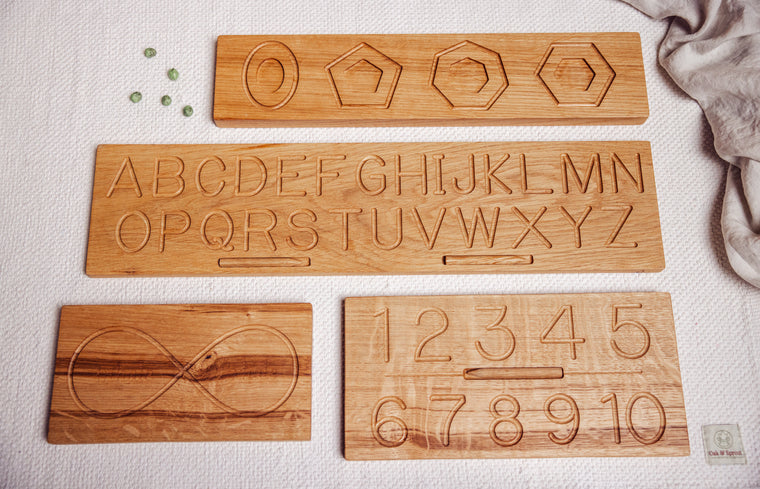
And yes — we do love the idea that a numbers board can quietly turn into a geography tangent at the kitchen table.
The guarantee
We make these to last. That’s the point.
So we back them with our multiple lifetime guarantee — because if you build something as a keepsake, you stand by it like a keepsake.